



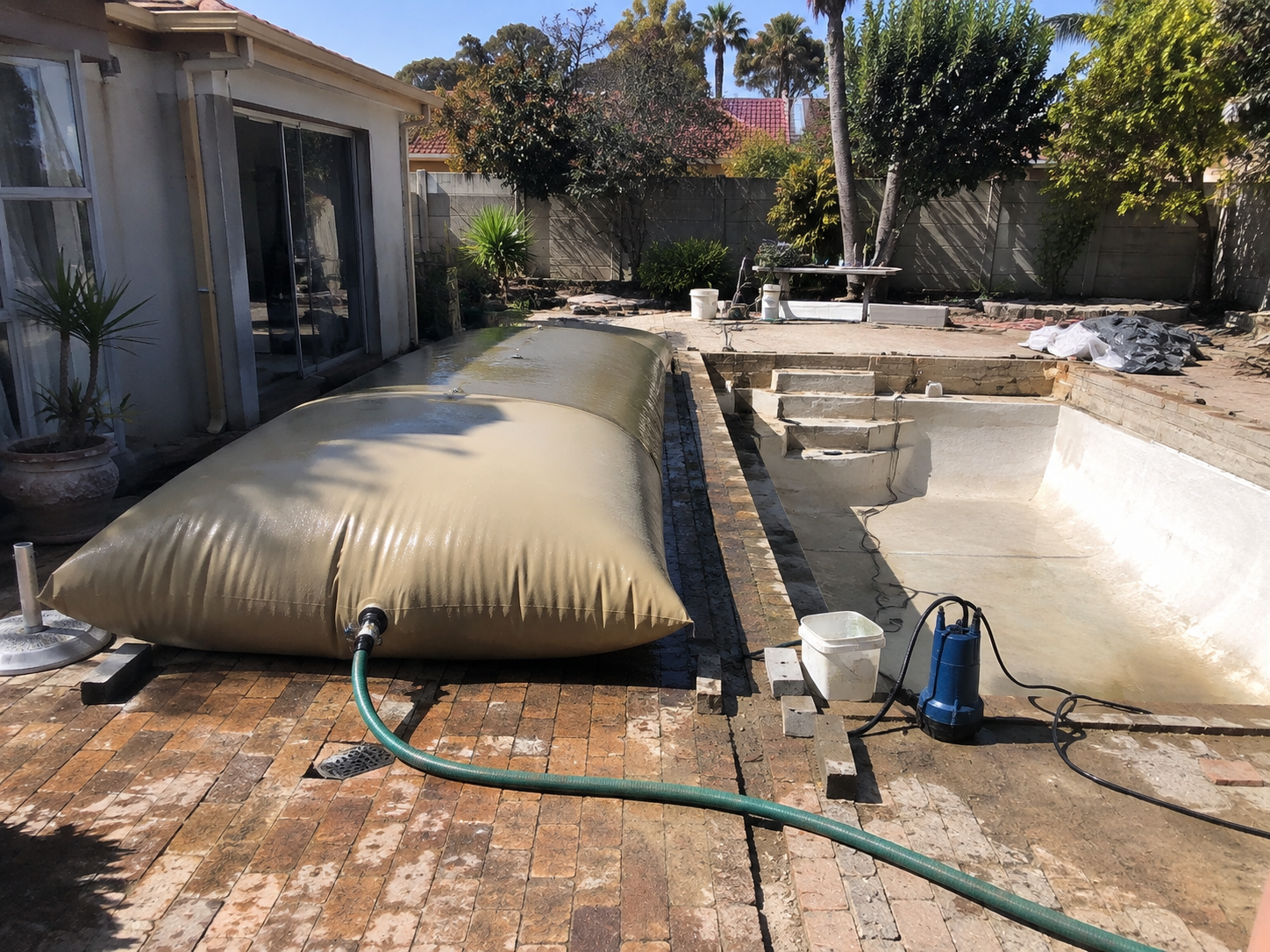
Water has always been one of Cape Town’s most valuable resources. The city’s experience during the drought and the threat of Day Zero changed the way many homeowners think about water, making conservation part of everyday life rather than just an environmental slogan. While rainfall has improved since then, the importance of using water responsibly hasn’t disappeared. Every litre that can be saved still makes a difference.
This is especially true during swimming pool renovations.
Many people are surprised to learn that a pool renovation doesn’t always mean draining thousands of litres of water down the nearest drain. In many cases, the existing water can be safely stored in large water storage bladders while renovation work takes place before being returned to the pool once the project is complete.
At first glance, this might seem like an extra step in the renovation process. In reality, it’s one of the smartest decisions a homeowner can make. Reusing existing pool water reduces waste, lowers costs, shortens the time it takes to get the pool running again and reflects a more responsible approach to water conservation.
For professional pool renovation companies such as Absolute Pools, using water storage bladders isn’t simply about convenience. It’s about protecting a valuable resource while making the renovation process more efficient for homeowners.
Planning a Pool Renovation?
Complete the form below and let Absolute Pools assess your swimming pool and recommend the most practical and cost-effective renovation approach, including responsible water storage where suitable.
What Is a Water Storage Bladder?
A water storage bladder is a large, heavy-duty container specifically designed to hold substantial volumes of water for temporary storage. During a swimming pool renovation, the existing pool water is pumped into the bladder before any work begins. Once the renovation has been completed and the pool is ready to be refilled, the stored water is pumped back into the pool.
Unlike makeshift storage methods, these bladders are manufactured to safely contain large quantities of water without leaking or contaminating it. They are available in different sizes, allowing contractors to choose one that matches the volume of the swimming pool being renovated.
To many homeowners, the bladder simply looks like a large temporary tank placed somewhere on the property. What they often don’t realise is the amount of water it is preserving. An average residential swimming pool can hold tens of thousands of litres of water. Draining all of that and replacing it unnecessarily can become both expensive and environmentally irresponsible.
Why Not Simply Drain the Pool?
It’s a fair question, and one many homeowners ask before a renovation begins.
After all, if the pool is already being emptied for repairs or resurfacing, why not let the water run away and refill it afterwards?
The answer becomes much clearer once you consider how much water is actually involved.
Even a modest residential pool can contain between 30,000 and 60,000 litres of water, while larger family pools may hold considerably more. Replacing that amount of water isn’t as simple as turning on the garden tap for a few hours. Depending on water pressure, it can take days to refill the pool completely.
Then there’s the cost.
Refilling a swimming pool isn’t just about paying for the water itself. Fresh water also requires balancing with the correct chemicals before it’s safe for swimming. That means additional chlorine, pH adjusters and other treatment products that wouldn’t necessarily have been required if the original water had been preserved.
When viewed this way, storing existing water often becomes the more practical option.
A Responsible Choice for Cape Town
Cape Town has become known around the world for the severe water crisis it experienced only a few years ago. While reservoirs have recovered and restrictions have eased, the lessons learned during that period remain just as relevant today.
Water conservation has become part of responsible home ownership.
Swimming pools are sometimes criticised because people assume they waste large amounts of water. In reality, a well-maintained pool loses surprisingly little water over the course of a year. The greatest water loss often occurs when pools are unnecessarily drained.
Choosing to store water during a renovation demonstrates that homeowners are thinking beyond the project itself. Instead of disposing of thousands of litres of treated water, they are preserving it for reuse once the work has been completed.
It’s a simple decision that reflects responsible water management while reducing unnecessary demand on municipal water supplies.
Saving Money Without Cutting Corners
Many homeowners initially view water storage bladders as an additional service that increases the cost of a renovation.
In practice, the opposite is often true.
Replacing tens of thousands of litres of municipal water can represent a significant expense, particularly for larger swimming pools. Once that fresh water has been added, it also needs to be chemically balanced before the pool is ready for use.
By preserving the existing water wherever appropriate, much of that expense can be avoided.
The financial benefit becomes even more noticeable for larger residential pools and commercial properties where water volumes are substantially higher.
Although every renovation is different, reusing suitable pool water can often reduce overall project costs while helping homeowners avoid unnecessary water charges.
It’s Not Just About the Water
One aspect that often goes unnoticed is how much time water storage can save.
Imagine completing a pool renovation only to wait several more days for the pool to refill completely.
Only once the pool is full can water chemistry be adjusted properly, filtration begin operating normally and the water gradually return to swimming condition.
When the original water has been stored in a bladder, much of this process happens far more quickly. The water is simply returned to the pool, circulation resumes and only minor adjustments may be needed before normal operation continues.
For homeowners eager to enjoy their newly renovated pool, shortening this waiting period is another valuable advantage.
When Can Pool Water Be Reused?
Although water storage offers many benefits, it isn’t suitable in every situation.
Professional pool contractors first assess the condition of the existing water before deciding whether it can safely be preserved.
If the water is reasonably clean, chemically stable and free from significant contamination, storing it often makes perfect sense. However, if the pool has been neglected for a long period, contains severe algae growth or has developed serious water quality issues, replacing the water may ultimately be the better decision.
Similarly, certain structural repairs or contamination events may require the pool to be completely emptied rather than preserving the existing water.
This is why reputable pool renovation companies don’t automatically recommend water storage for every project. Instead, they evaluate each swimming pool individually before deciding on the most appropriate approach.
Why Professional Handling Matters
At first glance, pumping water into a storage bladder might appear to be a straightforward task.
In reality, there is considerably more involved than simply connecting a hose.
The bladder must be positioned on suitable ground capable of supporting the enormous weight of thousands of litres of water. The transfer process needs to be carefully controlled to avoid damaging equipment or disturbing the stored water unnecessarily. Space around the property must also be considered to ensure the bladder doesn’t interfere with access or create safety concerns.
Equally important is protecting the stored water while renovation work is taking place.
When handled professionally, the process is organised efficiently from start to finish, allowing the renovation team to focus on restoring the swimming pool while ensuring the stored water remains suitable for reuse.
Not Sure Whether Your Pool Water Can Be Saved?
Tell us about your renovation project and Absolute Pools will advise whether storing your existing pool water is the most suitable option for your swimming pool.
Water Storage Makes Renovations More Sustainable
Sustainability isn’t only about installing solar panels or collecting rainwater. Sometimes it’s about making smarter decisions during projects that are already taking place.
Choosing to preserve existing pool water rather than disposing of it unnecessarily reduces waste without compromising the quality of the renovation.
It’s one of those decisions that benefits everyone involved.
Homeowners reduce unnecessary costs.
Less treated municipal water is wasted.
The renovation can often be completed more efficiently.
The environmental impact is reduced.
None of these benefits require sacrificing quality or taking shortcuts. Instead, they demonstrate that responsible construction practices and excellent workmanship can work together.
Common Misconceptions About Water Storage Bladders
There are several misconceptions surrounding water storage during pool renovations, particularly among homeowners who haven’t encountered the process before.
One of the biggest misunderstandings is that stored water becomes unsafe to reuse simply because it has been placed inside a bladder. In reality, professionally managed storage is specifically designed to keep the water suitable for temporary reuse, provided the water was in good condition before the renovation began.
Another misconception is that using a water storage bladder is only worthwhile during severe droughts. While water restrictions certainly highlight the importance of conservation, preserving thousands of litres of treated water makes financial and environmental sense regardless of the season.
Some homeowners also assume that every renovation automatically requires fresh water. As we’ve seen, that simply isn’t the case. Whether water can be reused depends on the condition of the pool, the type of renovation being carried out and the quality of the existing water.
Choosing a Pool Renovation Company That Values Water Conservation
Not every pool renovation company approaches water management in the same way.
When comparing contractors, it’s worth asking how they plan to manage your pool water throughout the renovation process. A company that considers water conservation as part of its overall project planning is often demonstrating the same attention to detail that will be applied throughout the renovation itself.
It’s not simply about using a water storage bladder. It’s about having a well-organised process that balances practical construction requirements with responsible environmental practices.
For many Cape Town homeowners, that’s becoming an increasingly important consideration when selecting a renovation specialist.
Conclusion
Pool renovations are an excellent opportunity to restore the appearance, safety and lifespan of a swimming pool, but they don’t have to come at the expense of thousands of litres of perfectly usable water. By storing existing pool water in specialised water storage bladders where appropriate, homeowners can reduce waste, lower refilling costs and return their pool to service more quickly once the renovation has been completed.
While water storage isn’t suitable for every project, it remains one of the simplest and most effective ways to make pool renovations more sustainable. The decision ultimately depends on the condition of the water, the scope of the renovation and a professional assessment of the pool itself.
As Cape Town continues to value responsible water use, preserving existing pool water wherever possible is more than just a practical choice. It’s a reflection of good planning, environmental responsibility and a renovation process that considers both the homeowner and the community.
Renovate Your Pool the Smarter Way
Whether you’re planning fibreglass relining, resurfacing or a complete pool renovation, Absolute Pools can advise on the best approach, including responsible water storage where it’s suitable for your project.


Comments are closed