

We provide specialized winterization services to safeguard your pool during the off-season, and when spring arrives, we handle the thorough opening process.
Recent Posts


Sign Up to get updates & news about us . Get Latest Deals from Walker's Inbox to our mail address.
Sign Up to get updates & news about us . Get Latest Deals from Walker's Inbox to our mail address.
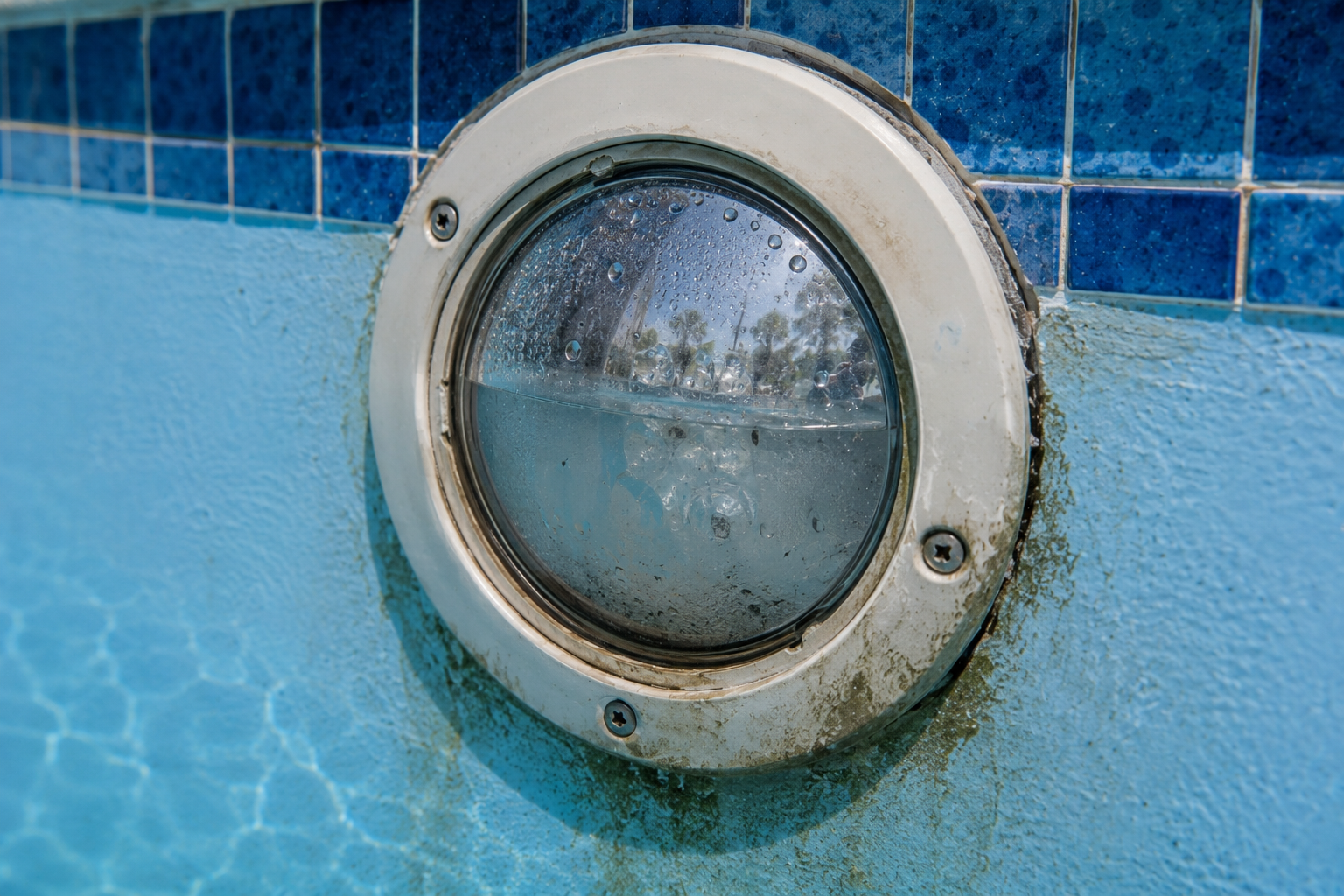
Water visible inside a swimming pool light can indicate a failed gasket, cracked lens, damaged fitting or moisture entering around the cable connection. Absolute Pools provides pool light inspections and repairs across Cape Town and surrounding areas.
A submerged pool light is designed to keep water away from its electrical components. The lens, housing, gasket and cable entry must work together to maintain a secure watertight seal.
When that seal fails, water can enter the fitting and collect behind the lens. The light may become cloudy, develop condensation, stop working or cause the electrical protection to trip.
Common causes include an ageing gasket, loose face ring, cracked lens, corroded housing, failed cable seal or a previous repair that was not assembled correctly.
Water inside a pool light should not be ignored. The circuit should be isolated until the fitting has been inspected and the electrical safety of the system confirmed.
Where specialised electrical testing, wiring or connection work is required, it should be completed safely by a qualified electrician.
A leaking pool light may show several visible or electrical symptoms:
A fitting that still illuminates can still contain water and should not be assumed safe simply because it remains operational.
A light mist or small droplets behind the lens may initially appear to be condensation.
Condensation can occur when moisture becomes trapped during assembly or when temperature changes affect air inside the housing. A properly sealed fitting should not continue developing significant internal moisture.
A visible water level, repeated misting or droplets that return after drying usually indicate that the seal has failed.
The fitting should be removed and inspected rather than repeatedly operated while moisture remains inside it.
Fill the form below and our team will be in touch with you shortly.
The gasket seals the lens against the light housing.
Rubber gaskets can harden, flatten, stretch or crack as they age. Once the gasket loses flexibility, it may no longer create consistent pressure around the lens.
A gasket can also leak when reused after the fitting has been opened. Even when it looks acceptable, its shape may no longer match the housing properly.
Replacing the gasket is often necessary whenever the light is dismantled.
A new gasket can still leak when it is twisted, pinched or positioned unevenly.
Dirt, grit, old sealant and corrosion on the sealing surfaces can prevent the gasket from sitting flat. Uneven tightening can create gaps around one part of the lens.
The housing and lens should be cleaned carefully before the fitting is reassembled.
The face ring holds the lens and gasket against the light housing.
Loose or unevenly tightened screws can reduce pressure on the seal. One side may remain secure while water enters through another section.
Overtightening can also crack the lens, distort the housing or damage the gasket.
The fasteners should be tightened evenly using a method suitable for the specific pool light.
A lens can crack through impact, ageing, heat stress or excessive tightening.
Fine cracks may be difficult to see until water begins entering the fitting. The crack can widen when the light heats during operation and cools after being switched off.
A cracked lens should be replaced rather than sealed externally as a temporary repair.
The metal or plastic housing can deteriorate through corrosion, chemical exposure and age.
Cracks, distorted edges and damaged screw points can prevent the gasket from sealing correctly. Water may continue entering even after a new gasket has been fitted.
Replacement may be more practical when the housing can no longer support a reliable seal.
Water entering the fitting can corrode electrical contacts, lamp holders, screws and internal metal parts.
The corrosion may appear green, white, brown or rust-coloured. Even after the leak is stopped, damaged internal components may remain unreliable.
The fitting should be inspected for both water entry and electrical deterioration.
The pool light cable enters the rear of the fitting through a sealed connection.
When this seal deteriorates, water can enter around the cable rather than through the lens. The fitting may continue leaking after the lens gasket has been replaced.
Cable-entry faults can be difficult to repair reliably on ageing lights and may justify complete replacement.
A pool light cable can become cracked, cut or brittle.
Damage may occur through age, previous repairs, movement in the conduit or the fitting being pulled too forcefully from the niche.
A damaged submerged cable should not be joined casually inside the pool. The repair must maintain the required electrical and waterproof integrity.
The light cable normally runs through a conduit from the pool niche to a connection point above the water level.
Water inside the conduit is not always unusual, depending on the design. However, failed sealing or incorrect termination can allow moisture to reach electrical connections where it should not be present.
The conduit, cable and junction point should be assessed together when the fitting and electrical connection repeatedly become wet.
The niche is the recessed section in the pool wall that holds the light fitting.
Cracks around the niche can allow pool water into the surrounding structure. This may not be the same as water inside the sealed light unit, but both problems can occur together.
A damaged niche can also contribute to water loss, staining and loose marbelite or tiles around the fitting.
The joint between the niche and pool wall may deteriorate over time.
Water can enter behind the pool finish or escape into the surrounding structure. Dark staining, algae, cracked grout and loose surface material may develop around the light.
The structural sealing around the niche should be repaired separately from the gasket inside the light fitting.
Using an unsuitable lamp, gasket, lens or retaining ring can prevent the fitting from sealing properly.
Parts that look similar may differ slightly in thickness, diameter or screw alignment. The light may close, but the gasket may not receive even pressure.
Replacement components should suit the specific fitting.
A pool light may leak again when an earlier repair used silicone or surface sealant without correcting the damaged gasket, lens or housing.
Sealant can make the fitting more difficult to open and may still fail under constant water pressure and temperature changes.
The previous material should be removed so the proper sealing surfaces can be inspected.
Older pool lights can develop several faults at the same time.
The gasket may be hard, the lens scratched, the screws corroded and the housing distorted. Repairing one component may not restore long-term reliability.
Complete replacement may be safer and more practical when the fitting has deteriorated extensively.
Fill the form below and our team will be in touch with you shortly.
Traditional halogen pool lights usually contain a replaceable lamp inside a sealed housing.
Water entering the unit can damage the lamp holder, reflector, connections and internal wiring. The heat produced by the lamp can also worsen a small lens or gasket defect.
The fitting should remain off until it has been opened, dried and inspected.
A conversion to a suitable LED pool light may be considered when the older fitting is corroded or repeatedly leaks.
Some LED pool lights use a sealed unit rather than a replaceable lamp.
When water enters a sealed LED fitting, internal electronics can fail and repair may not be practical. The light may flicker, change colour incorrectly or stop working completely.
The complete unit may need replacement, together with inspection of the cable, niche and transformer.
A cloudy lens often indicates moisture, mineral deposits or deterioration of the lens surface.
When the cloudiness is inside the fitting, the seal has likely been compromised. Continued operation can damage the internal components and create repeated electrical tripping.
The fitting should be isolated and inspected before the moisture becomes more severe.
Fill the form below and our team will be in touch with you shortly.
Flickering can result from moisture, corroded contacts, a loose connection, failing LED electronics or transformer problems.
The light may flicker only after warming up or after rain and wet weather. These patterns can help identify moisture-sensitive faults.
The circuit should remain off until the light and its electrical supply have been tested safely.
A pool light that trips the earth-leakage protection or circuit breaker may have water inside the fitting, damaged wiring or a transformer fault.
Repeatedly resetting the power is not a repair. The protective device may be responding to current leakage or another electrical safety problem.
The light circuit should be isolated and inspected by a suitably qualified person.
Rain can expose damaged junction boxes, transformers, conduit seals and outdoor electrical connections.
Cape Town’s winter rainfall may allow moisture into ageing equipment areas that remain dry during summer. The pool light itself may be sound while the fault sits at the transformer or connection point.
The complete light circuit should be checked rather than replacing the submerged fitting without testing.
Fill the form below and our team will be in touch with you shortly.
The absence of electrical tripping does not mean the fitting is safe.
Water may not yet have reached the live components, or the fault may be developing gradually. Corrosion can continue even while the light appears to operate normally.
The circuit should be switched off until the fitting has been assessed.
Water can cause the lamp, LED driver, transformer or internal connections to fail.
Replacing the lamp alone may not solve the problem if corrosion, cable damage or a failed seal remains. The fitting must be dried and inspected before new components are installed.
A complete replacement may be recommended when the housing or cable entry cannot be sealed reliably.
Brown or rust-coloured moisture can indicate internal corrosion.
Metal components may already be deteriorating, and the water can leave staining on the lens and housing.
The corrosion should be assessed before the fitting is reused. Severely damaged components may no longer provide reliable electrical contact or structural support.
Fill the form below and our team will be in touch with you shortly.
Green staining commonly indicates corrosion of copper-containing components.
Moisture may have reached terminals, wiring or internal connections. The staining can continue developing even after the light stops working.
The fitting should be inspected for internal damage and should not simply be dried and returned to service.
Black staining around the outside of the fitting may be algae, dirt or deterioration of the pool finish.
Algae often develops in the narrow joint around a pool light where brushing and circulation are limited. Cracks or failed sealing around the niche can make the problem more persistent.
The stain should be distinguished from electrical burning or corrosion inside the fitting.
A light that begins leaking after a globe replacement may have been reassembled with an old, damaged or incorrectly positioned gasket.
The lens and gasket surfaces may also contain grit or old sealant. Uneven tightening can leave a small gap around the housing.
The fitting should be reopened and assembled with suitable sealing components rather than relying on additional external sealant.
Fill the form below and our team will be in touch with you shortly.
Resurfacing, tiling and crack repairs can disturb the pool light niche and cable.
The fitting may have been removed and reinstalled using an old gasket. New marbelite or fibreglass can also interfere with how the face ring sits against the wall.
The light should be checked before the renovated pool is returned to normal use.
Fibreglass relining changes the surface around the niche and fitting.
Poor detailing around the light opening can leave gaps, uneven edges or stress around the housing. The fitting may also be reinstalled with an unsuitable seal.
The fibreglass, niche and pool light should be repaired as one coordinated area.
Leaks sometimes become visible only after the pool is refilled and the fitting is submerged again.
A gasket may appear secure while the pool is empty but allow water through under full pressure. The light should be observed before the circuit is energised.
If water enters shortly after filling, the fitting should be removed and resealed or replaced.
Fill the form below and our team will be in touch with you shortly.
An empty pool exposes the light, gasket and surrounding finish to heat and drying.
Older rubber seals may shrink or harden, while plastic and metal components expand at different rates. The fitting may begin leaking after the pool is refilled.
Pool lights should be inspected during renovation work while access is available.
A cracked lens should be treated as a failed waterproof barrier.
Even a fine line can allow water inside, particularly as the light heats and cools. Applying clear sealant over the outer surface is unlikely to provide a dependable submerged repair.
The lens and gasket should be replaced, or the complete light changed when suitable parts are unavailable.
A loose face ring may allow the fitting to move inside the niche.
The lens seal can lose even pressure, and the light may rattle or sit unevenly against the pool wall. Missing or corroded screws can make proper reassembly difficult.
The retaining components should be repaired or replaced before the light is operated again.
Fill the form below and our team will be in touch with you shortly.
A light fitting is normally secured inside the niche with a retaining screw or suitable clip.
If it comes loose, the cable and housing can be placed under strain. Water may enter through an already damaged seal, and the exposed fitting can create a hazard for swimmers.
The light should be secured correctly after the housing, cable and niche have been inspected.
Pool lights are usually installed with enough spare cable to allow the fitting to be lifted above the water for servicing.
A cable that is too short may prevent proper maintenance and encourage technicians to work on the fitting while it remains submerged.
Extending or replacing submerged pool-light cables requires an appropriate waterproof and electrically safe solution.
Yes. The light circuit should be isolated when water is visible inside the fitting or the light behaves abnormally.
Switching the wall switch off may not provide the same isolation as turning off the appropriate circuit at the distribution board.
Do not handle or open the fitting until the circuit has been made safe.
Fill the form below and our team will be in touch with you shortly.
The pool pump and pool light are often on separate circuits.
The pump may continue operating when its electrical system is unaffected and safe. However, the layout differs between properties, and the equipment should not be assumed independent without confirmation.
Where the same electrical fault causes wider tripping, the affected circuits should remain off until they have been inspected.
Many pool lights are designed to be removed from the niche and lifted above the water using the spare cable.
The fitting can then be opened, dried and repaired while the pool remains filled. The water may need to be lowered when the niche, conduit or surrounding pool finish requires work.
The pool should not be drained unnecessarily, particularly where groundwater or structural movement could be a concern.
Fill the form below and our team will be in touch with you shortly.
A fitting may be reusable when the water entry is recent and the internal components remain undamaged.
The housing must be opened, dried and inspected for corrosion, electrical damage and deterioration of the gasket, lens and cable entry.
Drying alone is not enough. The cause of the leak must be repaired before the fitting is returned underwater.
Silicone applied around the outside of the lens is not a dependable substitute for a suitable gasket and sound housing.
The sealant may peel, trap contamination or make later servicing difficult. It can also hide cracks without restoring proper compression between the components.
The fitting should be dismantled and repaired using suitable parts.
Resealing may be suitable when:
The fitting should be tested before it is returned to normal service.
Fill the form below and our team will be in touch with you shortly.
Replacement may be more practical when the housing is cracked, badly corroded or no longer accepts a reliable gasket.
A sealed LED unit with water inside commonly requires replacement. Older halogen fittings may also be replaced when parts are unavailable or repeated repairs have failed.
The replacement should be compatible with the pool niche, cable route, transformer and electrical supply.
Many older lights can be upgraded to a suitable LED pool-light system.
The existing niche, cable, transformer and supply must be assessed for compatibility. Some conversions use a replacement lamp, while others require a complete new fitting.
The waterproof seal and electrical installation remain important regardless of the light technology.
Low-voltage pool lights commonly operate through a transformer.
A faulty transformer can cause flickering, dim operation, complete failure or tripping. Moisture, overheating and ageing can damage the unit.
The transformer should be installed in a suitable location and tested as part of the complete light circuit.
Replacing the submerged fitting will not solve a transformer fault.
Fill the form below and our team will be in touch with you shortly.
Electrical connections should remain protected from pool water, rain and irrigation.
A cracked or poorly sealed junction box can allow moisture onto the cable connections. The fault may become noticeable only after wet weather.
The connection point, conduit and cable should be checked when the pool light repeatedly trips or behaves intermittently.
Absolute Pools inspects the lens, face ring, gasket, housing, cable and visible condition around the light niche.
The fitting is checked for moisture, corrosion, damaged seals, cracked components and evidence of previous repairs. The surrounding marbelite, fibreglass, tiles and grout are assessed where the niche may also be leaking.
The transformer, junction point and electrical behaviour may require testing where the light trips, flickers or fails.
Where specialised electrical work is required, it should be completed safely by a qualified electrician.
The assessment determines whether the light can be resealed, needs replacement parts or should be replaced completely.
Resealing begins with safely isolating the electrical supply and removing the fitting from the niche.
The housing is opened, and the water is drained. The lens, gasket channel and sealing surfaces are cleaned and inspected.
A suitable new gasket and damaged components are replaced. The fitting is reassembled evenly and tested before being returned to the niche.
Internal corrosion or cable-entry damage may make resealing unsuitable.
Fill the form below and our team will be in touch with you shortly.
A cracked lens and old gasket are removed from the housing.
The internal components are inspected and dried. Corroded or damaged parts are replaced where practical.
The correct lens and gasket are fitted, and the retaining ring is secured evenly.
Using components suited to the specific light model helps restore a more reliable watertight seal.
Complete replacement may be recommended when the fitting is obsolete, repeatedly leaks or has extensive internal corrosion.
The existing light is removed, and the niche, cable and electrical supply are assessed. A suitable replacement unit is installed and tested.
The transformer may also need replacement or adjustment when changing between older and newer lighting systems.
The surrounding niche and pool finish are repaired where water entry or movement has caused additional damage.
Cracks, failed grout and loose marbelite around the niche are removed back to secure material.
The niche and pool wall connection are inspected for water loss and structural movement. Damaged areas are repaired and sealed before the finish is reinstated.
Niche repair and light fitting repair are separate tasks but may be completed during the same project.
Fill the form below and our team will be in touch with you shortly.
A pool that loses water near the light level may have a leaking niche, conduit or crack around the fitting.
Testing can help determine whether water is escaping around the niche or whether the visible moisture is limited to the sealed light housing.
The conduit and surrounding structure may require further investigation where the water level repeatedly stabilises near the light.
Replace old gaskets whenever the fitting is opened and use parts suited to the specific light.
Keep the lens, gasket channel and housing clean during assembly. Tighten retaining screws evenly without overtightening them.
Address cracks, loose tiles and failed grout around the niche before water reaches behind the pool finish.
Do not allow an empty pool to remain exposed longer than necessary during renovations. Inspect the light before refilling when it has been removed or disturbed.
Switch off and investigate pool lights that flicker, trip or develop moisture rather than continuing to operate them.
Absolute Pools inspects and repairs swimming pool lights with water inside across Cape Town and surrounding areas, including the Northern Suburbs, Southern Suburbs, Atlantic Seaboard, Cape Town City Bowl, West Coast suburbs and Helderberg.
Service areas include Durbanville, Bellville, Brackenfell, Kraaifontein, Parow, Goodwood, Milnerton, Table View, Parklands, Blouberg, Century City, Pinelands, Rondebosch, Claremont, Newlands, Constantia, Tokai, Wynberg, Plumstead, Hout Bay, Sea Point, Green Point, Camps Bay, Somerset West, Strand, Gordon’s Bay, Stellenbosch, Paarl and surrounding areas.
Fill the form below and our team will be in touch with you shortly.
Absolute Pools checks the lens, gasket, housing, cable, niche and surrounding pool finish before recommending repairs.
We assist with pool light resealing, lens and gasket replacement, fitting replacement, niche repairs, leak detection and related pool surface work.
Our focus is on identifying how the water entered and restoring a reliable seal rather than applying temporary sealant around a damaged fitting.
Water inside a pool light can damage internal components, corrode the fitting and contribute to electrical tripping.
Keep the affected light switched off and contact Absolute Pools for pool light inspection and repairs across Cape Town and surrounding areas.
Fill the form below and our team will be in touch with you shortly.
WhatsApp us